
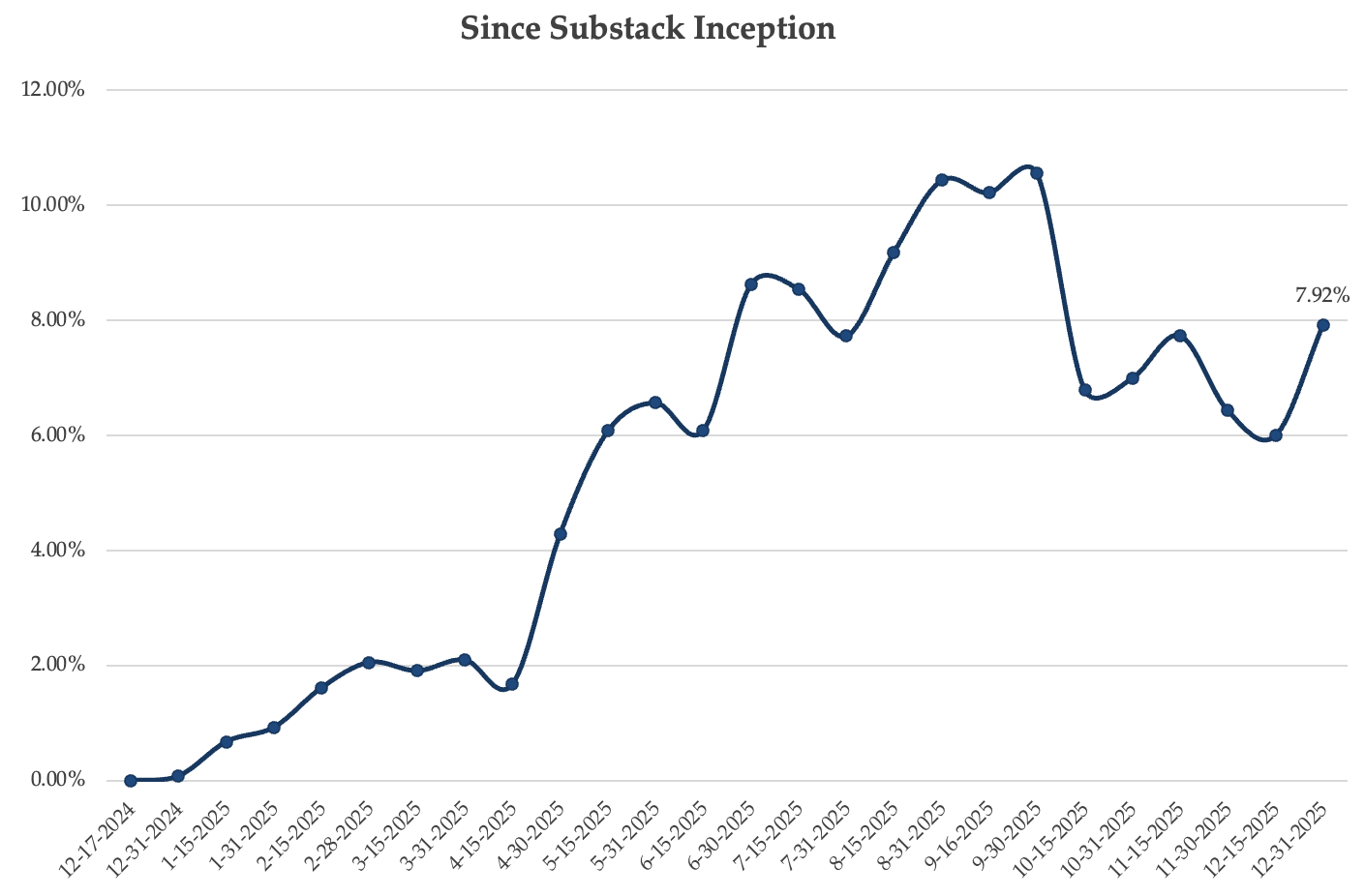
+7.91% in 2025
Steady compounding in line with historical trends

Happy New Year! May 2026 bring you very good health, love, and prosperity. In this blog, I’ll cover the highlights of the strategy: return and how we’ll be positioned in 2026.
Overall, if you’re looking at absolute return goals, the strategy delivered on the 6-8% return range we’ve seen historically. During periods of declining implied volatility (or low volatility), we tend to lag and are more subject to directional risk. 2025 was no exception as the first half was characterized by fairly volatile and sideways markets, during which we’ve earned the entire full-year return.
I don’t know what 2026 will bring but if we see a pick-up in volatility and relative outperformance for some of the defensive quality names that have been lagging, it should be a good year for us. We stick to quite simple research: higher volatility equals lower risk if you’re then adding to your portfolio. When volatility’s low, usually risks are higher. Really, it’s all about being contrarian and making sure you can scale positions when needed. Most investors sell out when market volatility’s too high to stomach, and then they buy again when there’s a false feeling of safety.
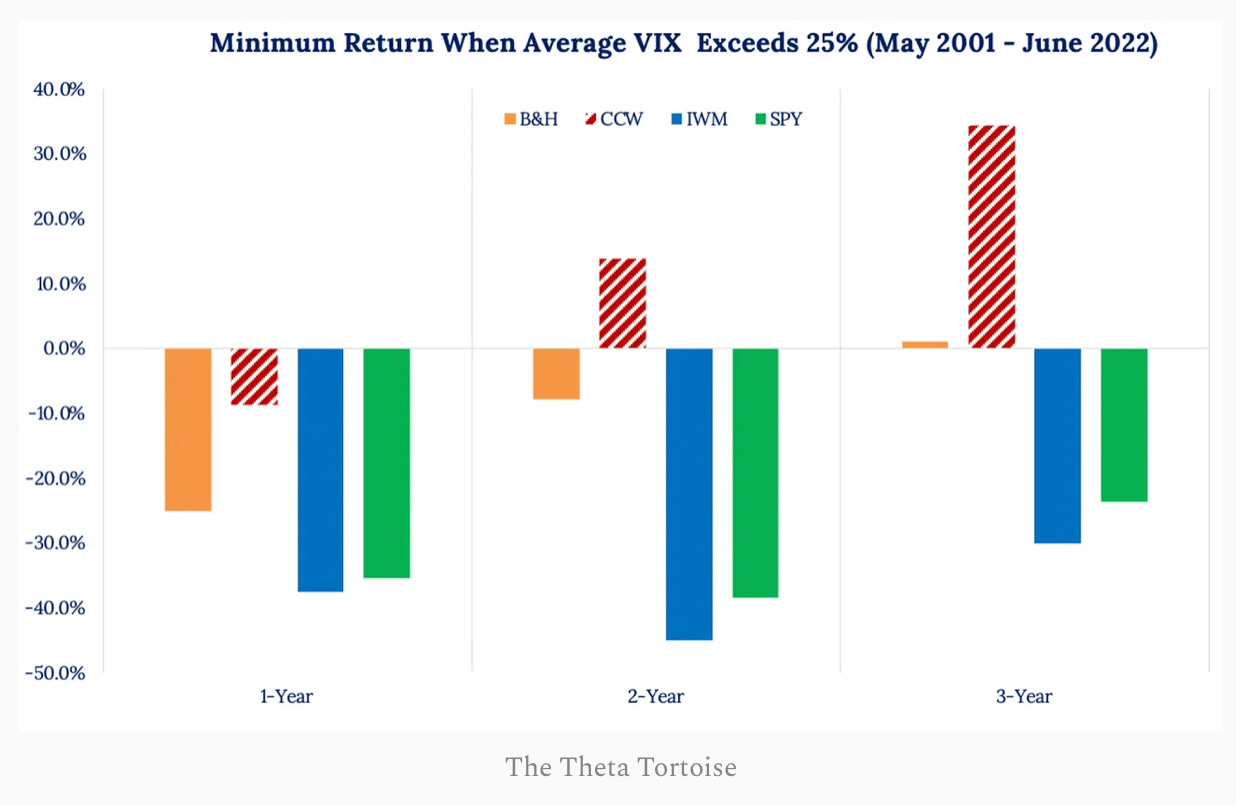
As we talked about in our previous study on covered-calls and defensive stocks, the VIX gives us plentiful insights. Keep in mind that the strategy was backtested on a rolling basis (i.e. continuously rolling the position, in both low and high VIX environments):
higher implied volatility hurts passive investing, only to the extent that higher implied volatility stays bid for a longer period of time (i.e. no V-shape patterns where volatility spikes, stocks go down, and revert quickly);
a strategy that is long defensive stocks and sells covered-calls (or holding cash and selling a put, that’s the same pay-off (barring any differences in implied volatility) is less correlated with the overall market;
the benefits from selling premium compound over time, and ideally when there’s decent/normal implied volatility (18-20% VIX);
there’s always downside risk, but the max. drawdown after 1-year decreases. And the probability of seeing such down move is when the VIX transitions from a low to high regime. With our cash-secured put strategy, we scale our positions as IV/VIX increases.
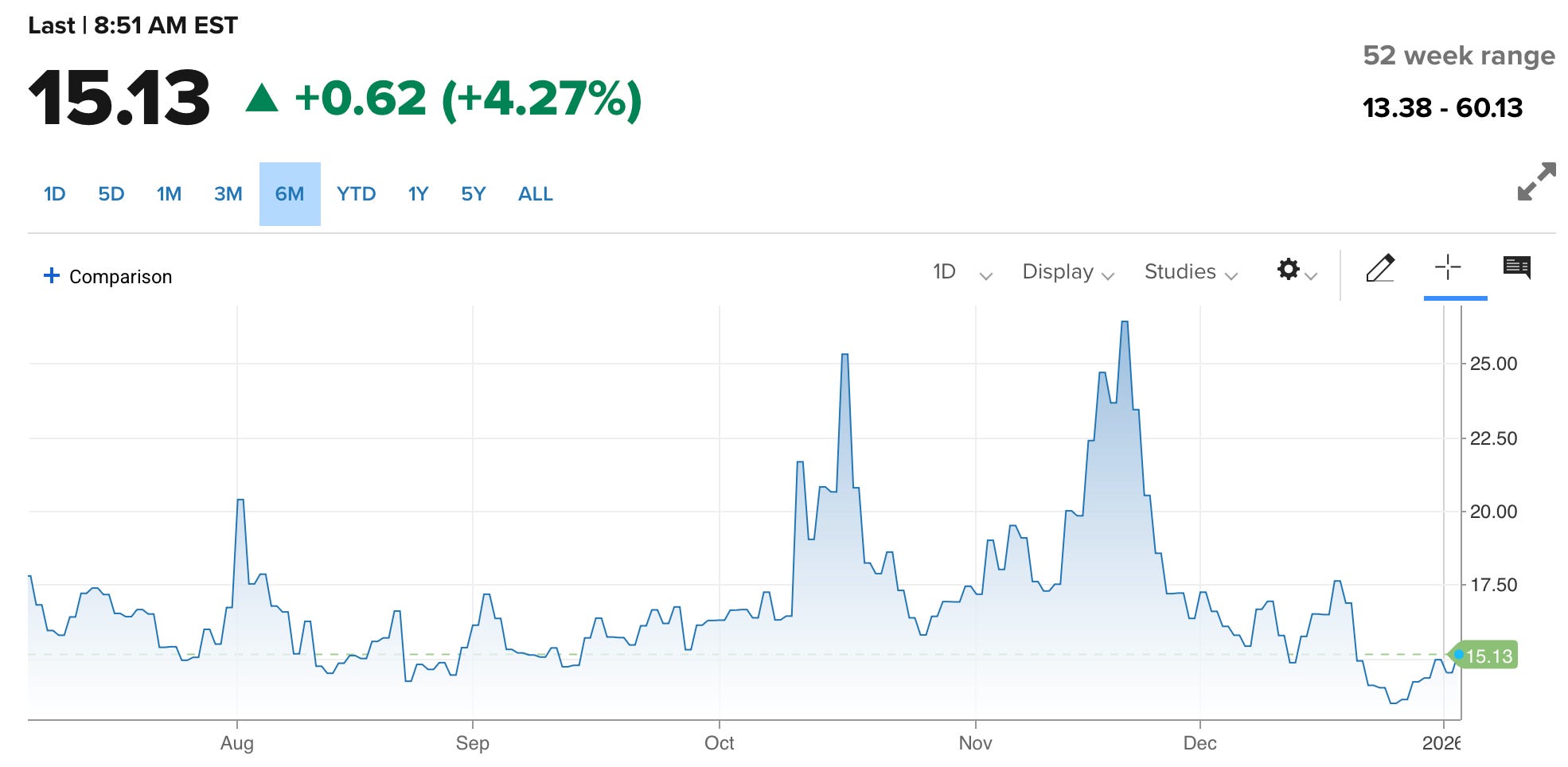
Right now, the VIX is quite subdued but it’s been increasing. Still, this remains a risk-on market until it isn’t anymore.
Today’s Positions
Referring to the last post with our positions overview, we haven’t changed anything.
We’ve got a couple of positions that will expire mid-January, including the two year setups that are at a good profit level - perfectly in line with expectations and what we’ve communicated late 2024 when launching the Substack.
We won’t extend the one-year setups (30% of the capital) as the longer-term implied volatility has picked up and we believe that 2026 could be surprisingly volatile (whether it be bullish or bearish) for defensive quality. These 1-year setups benefit from increasing implied volatility and sideways markets but with both implied volatility quite high and risk of outliers, it’s not a good time to put on new positions imo.
As such, there’s going to be a lot of free cash available to deploy whenever we see a spike in the VIX on top of holding some more directional positions. With the strategy, we’ve survived the April 2025 downturn but we weren’t as nearly aggressive as one would have hoped for during the May-July recovery.
In hindsight, the peak in the VIX at 60% should have made us place more directional recovery bets. Even more steady compounders such as Visa rebounded 20% or more over a two-month span.
Still, one could have said the same when the VIX exceeded 30% and then accelerated further - you’ll never catch the perfect buying opportunity. I did buy more during April in my long-only equity portfolio (The Compounding Tortoise Portfolio).
Overall, I feel optimistic about the prospects of this options strategy because it’s based on outperforming during tougher times. Winning by losing less, and therefore, being able to stay put when others are forced to cut back.
Congrats! Learned a lot !